Just as a master-crafted timepiece or a rare vintage wine holds its value through the decades, your art collection should be built on a foundation of permanence. If you’ve ever walked through a high-end gallery and wondered why one photograph costs $50 while another commands $5,000, you’ve stepped into the world of archival quality. For collectors and high-value art seekers, the difference isn't just in the image itself, it's in the chemistry, the paper, and the long-term investment strategy that ensures your piece remains a legacy asset.
When you invest in limited edition photography prints, you aren't just buying a pretty picture for your wall; you are acquiring a piece of history. But history only matters if it doesn’t fade away. That is where archival standards come in, transforming your purchase from a decorative item into a legitimate alternative asset.
What Actually Makes a Print 'Archival'?
Many people use the term "museum quality" as a buzzword, but in the world of professional fine art, it has a very specific meaning. To be considered museum quality prints, the materials used must be chemically stable and designed to resist the ravages of time, light, and humidity.
Standard prints, like the ones you might get from a local pharmacy or a cheap online lab, use dye-based inks and papers treated with acid. Over time, these acids eat away at the fibers, and the dyes break down when exposed to UV light. The result? Your beautiful landscape starts looking like a yellowed relic from a 1970s garage sale within a few years.
True archival prints utilize pigment-based inks on acid-free, 100% cotton rag or alpha-cellulose substrates. These materials are engineered for a lifespan of 100 to 200 years. By choosing these, you are ensuring that the vibrancy and detail you see today will be exactly what your grandchildren see decades from now.

The Science of Permanence as a Financial Metric
As an art buyer, you should view permanence as a direct financial metric. The technical durability of a print converts directly into investment security. Think about it: if you buy a piece of art for $3,000 and it begins to degrade or discolor in ten years, your investment has effectively evaporated.
In contrast, archival materials create measurable differentiation in the market. When a work is created using giclée printing processes rated for 100+ years, it maintains its visual integrity. This physical survival prevents the value deterioration that plagues mass-produced decor. This is why curators and serious collectors only look at pieces that meet these rigorous standards.
| Feature | Standard Print | Archival Print |
|---|---|---|
| Ink Type | Dye-based (fades quickly) | Pigment-based (UV resistant) |
| Paper Base | Wood pulp (acidic) | 100% Cotton Rag or Alpha-Cellulose |
| Expected Lifespan | 5–15 years before fading | 100–200+ years |
| Investment Value | Decorative only | High resale potential |
| Texture/Feel | Flat, plastic-like | Rich, tactile, painterly |
If you’re a photographer looking to reach this level of quality in your own work before printing, check out my Ultimate Lightroom Preset Collection to ensure your files have the professional depth and color science required for high-end output.
Limited Edition Photography Prints and Scarcity Economics
The magic of art investment lies in the balance between quality and scarcity. When you acquire limited edition photography prints, you are buying into a finite supply. Archival standards align perfectly with these scarcity economics. Because these prints won’t degrade, the edition remains genuinely rare.
Imagine a series of only 10 prints. If those prints were made on cheap materials, five might be ruined by sunlight or moisture over twenty years, leaving only five in "good" condition. However, because archival prints preserve themselves, the entire edition retains its collective market power. This creates a stable secondary market where collectors can confidently trade pieces, knowing the physical asset is still in pristine condition.

The Importance of the Certificate of Authenticity for Art Prints
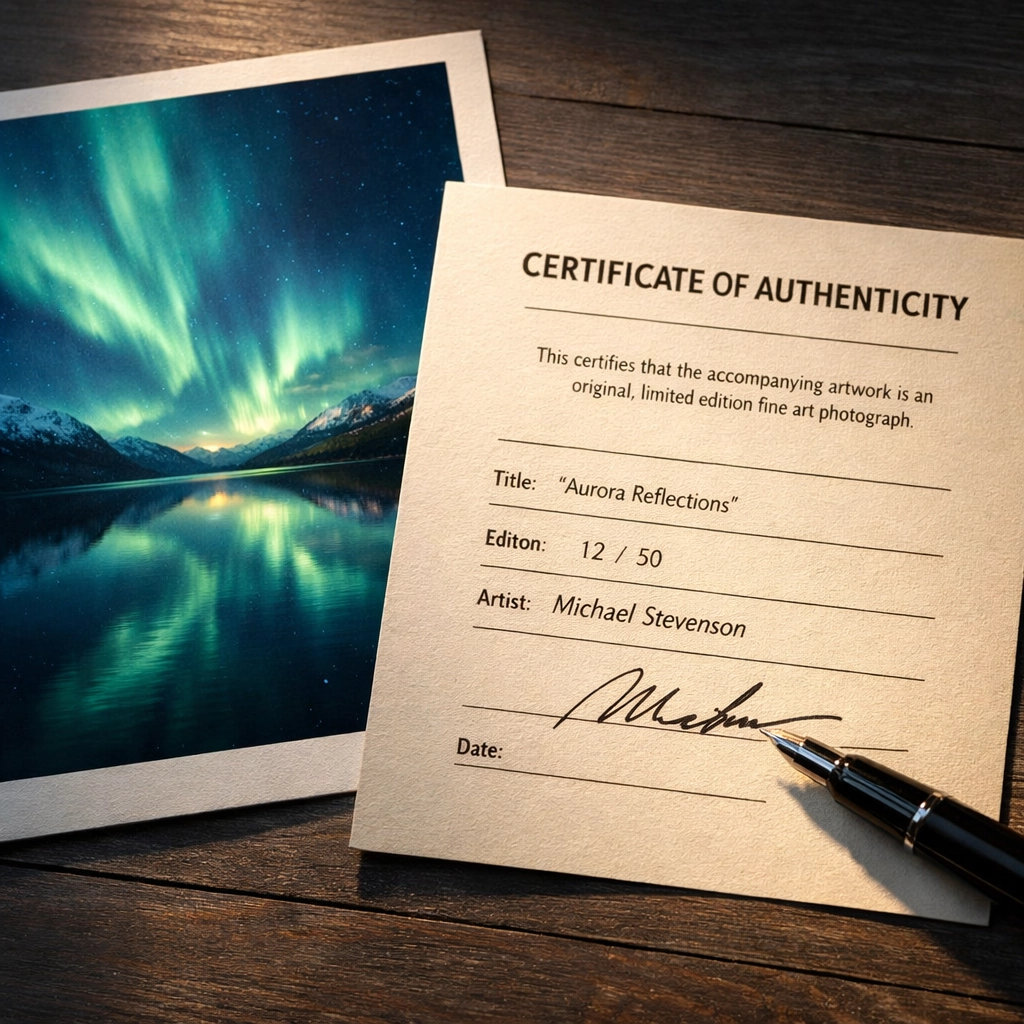
You wouldn't buy a diamond without a GIA report, and you shouldn't buy high-value photography without a certificate of authenticity for art prints. This document is the backbone of your investment’s provenance. It proves that the work is an original creation of the artist, specifies the edition number, and, crucially, details the archival materials used.
A proper certificate should include:
- Artist Name & Signature: Direct link to the creator.
- Title of the Work: The specific name of the piece.
- Edition Number: (e.g., 2 of 10).
- Date of Printing: When the physical object was brought to life.
- Technical Specs: The printer, ink type, and paper used.
This documentation becomes part of the permanent record. When you go to sell or donate your collection, this certificate is what the appraiser or auction house will demand to verify the value. For those looking to start their collection with verified, world-class imagery, you can explore the curated galleries at Edin Fine Art.
How to Sell Fine Art Photography Prints Later
A common question for new collectors is: "Once I have this, how do I eventually liquidate the investment?" Knowing how to sell fine art photography prints is just as important as knowing how to buy them.
The resale market for photography is robust, but it relies entirely on the condition and documentation of the piece. If you have kept your archival print in a UV-protected frame or a climate-controlled environment, you have a high-value asset. You can work with specialized art brokers, high-end auction houses, or even private collector groups.
Because photography is more accessible than traditional oil paintings but possesses the same permanence guarantee when printed archivally, it is an entry point for diversifying your holdings without sacrificing long-term growth. To understand more about the commercial side of the industry and how high-end imagery is produced for brands and collectors alike, visit Edin Studios.
Building a Soft Gallery in Your Home
Investing in photography isn't just about the numbers; it’s about the daily experience of living with beautiful objects. When you choose museum-quality pieces, you are creating a "tactile anchor" in your living space. The way light hits a cotton-rag archival print is fundamentally different from how it reflects off a glossy, mass-produced poster. There is a depth, a texture, and a "soul" to the paper that commands attention.
Whether you are looking for the minimalist blue hour of White Sands (okay, that link is for NYC, but you get the vibe!) or the vibrant energy of a city landscape, the medium matters. If you are ever in the market for specific location-based art, we have guides and prints ranging from the Everglades to Miami Beach.

Why the Market is Shifting Toward Photography
We are seeing a massive boom in collectors under 40 who view photography as the ultimate modern investment. It bridges the gap between the digital world we live in and the physical world we want to preserve. By focusing on archival standards, you are participating in a market that values transparency, technical excellence, and artistic vision.
The shift is simple: People want to know that what they buy today will exist tomorrow. Archival prints provide that peace of mind. They turn a moment captured in 1/1000th of a second into a century-long legacy.

Hence, when you're ready to take the leap into fine art photography, remember that the "paper" is just as important as the "picture." Look for the pigment, demand the cotton rag, and never walk away without your certificate of authenticity. Your future self (and your portfolio) will thank you.
For more insights on how to elevate your work, explore our site for a deep dive into hundreds of tutorials and guides. Whether you are a collector looking for your next piece at Edin Fine Art or a photographer looking to hone your craft, we are here to guide you through the beautiful, complex world of fine art photography.
Fine Art Photography Prints
Own a museum-quality archival print by Edin Chavez
Hahnemühle archival paper · From $95
BROWSE PRINTS LIMITED EDITIONS