Fine Art Photography
# Grand Canyon at Sunset: Why This Remains America’s Most Collected Landscape Photograph
I’ve stood at the South Rim of the Grand Canyon in every kind of light — flat midday light that makes it look like a postcard, overcast winter light that strips it of color, and that specific late-afternoon light in October that I had driven ten hours to find. I’ve also stood there with five million other visitors, watching them raise their phones, take a shot, and move on. I understand the impulse. The scale of the canyon is so disorienting that your first instinct is to document it, to prove you were there. But documentation and art are not the same thing, and the difference between a tourist snapshot and a fine art Grand Canyon photography print is the difference between a memory and an experience you can give to someone who was never there.
I don’t shoot the Grand Canyon on a schedule. My first trip for the image I was after, I spent two full days watching the light move across the canyon and went home without tripping the shutter once. The light was wrong both days — the atmosphere too clear, the sunset too uniform, the colors too predictable. I drove back to Flagstaff, booked another night, and came back at 4 a.m. on the third day.
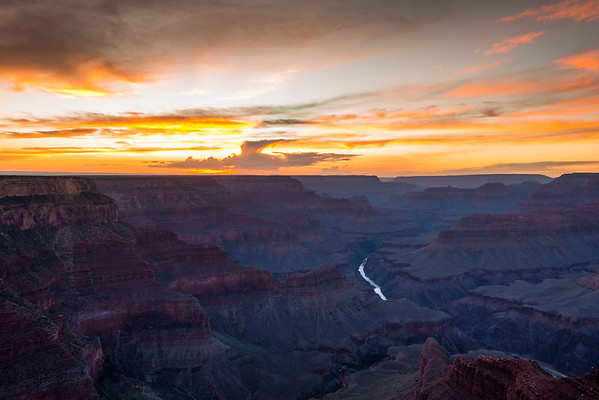
The position I’d chosen was not the Mather Point overlook, where most visitors gather. I’d found a spot slightly east and lower, accessible by trail, where the canyon’s inner gorge opened up to place the Colorado River in the lower left of the frame — a silver thread visible for only a few hundred yards before disappearing behind a wall of Vishnu Schist. The foreground was a ledge of pink Kaibab limestone that I knew from the previous two days would go almost amber in certain light.
What I was waiting for was the transition moment — when the reds deepened past their peak, before the shadows filled the gorge and collapsed the depth. That window is often less than eight minutes. On the third evening, I had it. The canyon moved through red, then a burnished gold I hadn’t seen on either previous day, and finally into a deep violet that seemed to come from inside the rock rather than from the sky above it. I shot 43 frames in those eight minutes. One is the image that has hung in more living rooms, hotel lobbies, and private offices than any photograph I’ve ever made.
I make my Grand Canyon photography print available in several sizes, but I always have the same conversation with collectors considering smaller formats: for the Grand Canyon specifically, the minimum size that does justice to the image is 40×60 inches.
This is not preference. It is the nature of the subject. The Grand Canyon is the largest canyon on Earth. It has layers of geological history visible simultaneously across a vertical face of more than a mile. When you compress that onto a surface smaller than 24×36 inches, you lose the quality that makes the image powerful — the sense that you are standing at the rim, that the space in front of you is genuinely immense.
At 40×60, printed on archival baryta paper with the full tonal range of the original file, the image does something I’ve watched happen in real time: it commands the wall instead of decorating it. Collectors who have placed this print as a focal piece above a fireplace or on a ten-foot office wall consistently report the same effect — guests stop in front of it the way they stop in front of a painting, not a photograph. That response is what large-format fine art photography is capable of, and what no smaller reproduction can replicate.
Every year, approximately five million people visit the Grand Canyon and virtually all of them take a photograph. The vast majority of those images are interchangeable: dramatic, wide, colorful souvenirs of a place, not interpretations of it.
The discipline I developed working for National Geographic — which expects images that have never been made before — is the discipline of patience and specificity. A fine art photograph of the Grand Canyon is an argument about the canyon: that at this particular moment, from this particular position, in this particular light, the canyon reveals something that no other conditions would show. That specificity is what separates a fine art Grand Canyon photography print from a souvenir. Collectors aren’t acquiring a photograph of a famous place — they’re acquiring a singular interpretation of it that will not be made again.
The question I hear most from interior designers and collectors is: where does this image live?
The honest answer is almost anywhere the wall can hold it. I’ve seen it in the entry hall of a contemporary home in Coral Gables, where the warm violet of the canyon’s shadow tones complemented travertine floors and neutral walls. I’ve seen it in a corporate boardroom in Midtown Manhattan, 60×90 inches on a charcoal accent wall, where it communicates something about scale and vision that no decorative art could. Hotel lobbies are among the most natural homes for this print — large-format, authoritative, immediately communicating that the property values presence over generic design.
It works across aesthetics because it isn’t trendy. The Grand Canyon has been there for six million years. The light I captured that October evening is the same light the first explorers saw. That kind of permanence produces art that doesn’t date.
This Grand Canyon photography print is a limited edition of 50, across all sizes combined. I’m currently in the early phase of the edition, which means current pricing will not hold for the full run. As the edition closes, the price increases, and once edition 50 is sold, the image will not be reproduced under any circumstances.
Collectors who purchased my earlier limited-edition landscape work at first-release pricing have seen current market prices more than double as those editions closed. The Grand Canyon is my most-requested image. I expect this edition to follow a similar trajectory.
Simple arithmetic applies: the later you wait, the higher the price and the fewer numbers remaining.
This image represents three days of work, twenty years of craft, and one perfect evening of light. I would be honored for it to have a place in your home.