With a rich history spanning centuries, photography has transformed from the simple principles of the camera obscura to the sophisticated digital systems we use today. You will explore the key milestones that have shaped this art form, uncovering how advancements in technology, materials, and techniques have influenced both the creation and perception of images. Join this enlightening journey that will enhance your understanding of photography’s evolution and inspire your own creative endeavors.
From Light to Image: The Birth of Photography
This era marked a significant shift in how you could capture images, transitioning from mere projections of light to creating permanent representations. The revolutionary invention of photography brought new opportunities for documentation, artistry, and communication, laying the groundwork for generations of photographers to come. You will soon discover how early experiments and innovations made it feasible to preserve fleeting moments through this fascinating medium.
The Camera Obscura and Its Principles
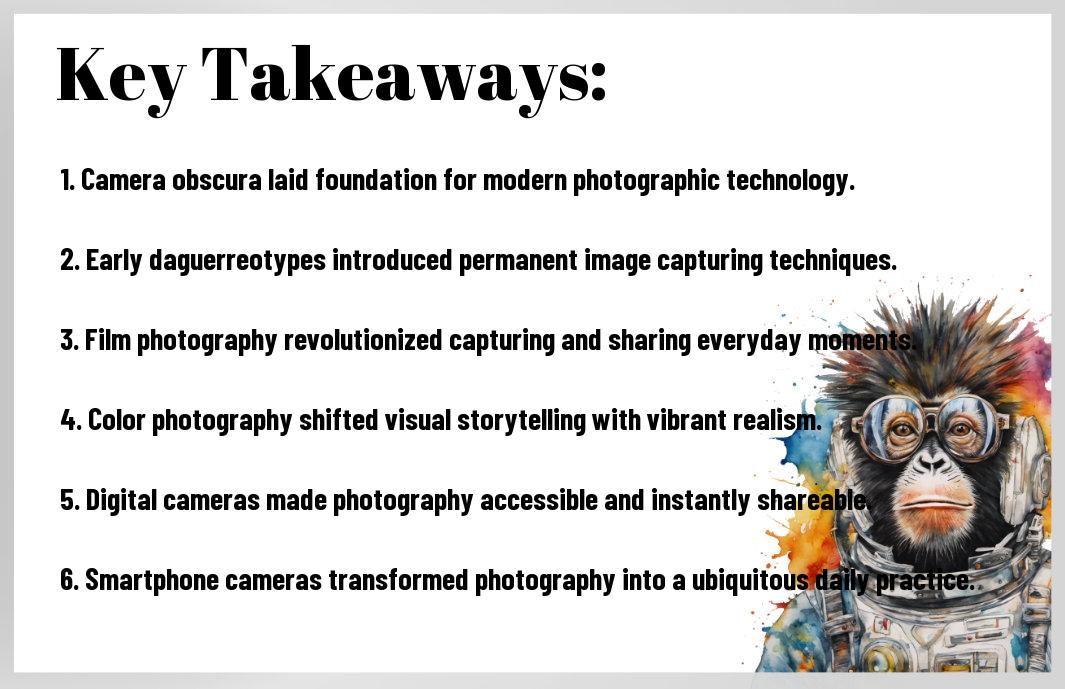
The camera obscura, a precursor to modern photography, operated on a simple principle where light enters a darkened chamber through a small opening, projecting an inverted image of the outside scene onto the opposite wall. This device enabled artists and scholars to explore perspective and composition long before photography was born. By experimenting with lenses, you could manipulate the sharpness and clarity of these projections, paving the way for future advancements in capturing images.
The Invention of the Daguerreotype
The daguerreotype emerged as the first practical method of capturing photographs in 1839, developed by Louis Daguerre in France. This revolutionary process involved exposing a silver-coated copper plate to light, which created a detailed, one-of-a-kind image after chemicals developed it. It drastically reduced exposure times to around 20 minutes, allowing you to capture still images of people and landscapes, helping to popularize photography in a way never seen before.
The daguerreotype process offered unprecedented detail and clarity, producing images with a richness that few had ever encountered. Each exposure yielded a unique, finely detailed photograph, making them coveted possessions. With the introduction of the daguerreotype into salons and studios worldwide, you could finally experience the thrill of seeing your likeness captured in a way previously thought impossible. Its invention sparked great enthusiasm, leading to the establishment of photography studios, and igniting a passion for documenting life, which continues to thrive in your world today.
The Technological Breakthroughs That Changed the Game
Advancements in technology have continuously reshaped photography, introducing innovation that transforms not just how you capture images but also their accessibility. The introduction of electric lighting, the invention of photographic films, and the development of digital sensors have all played pivotal roles. Each breakthrough has brought new possibilities for expression, creativity, and documentation, changing the landscape of visual storytelling forever.
The Advent of Film and Its Impact on Photography
The arrival of film in the late 19th century revolutionized photography, allowing images to be captured more easily and with improved quality. Rather than relying on glass plates, photographers could now use flexible, portable film strips that were light-sensitive. This shift enabled more spontaneous photography and ushered in the era of amateur photographers, making the art form widely accessible and changing professional practices forever.
Color Photography: A Revolution in Visual Art
Color photography emerged in the early 20th century, dramatically altering the visual landscape and bringing life to images in unprecedented ways. Early methods, such as the Autochrome plate introduced in 1907, stirred excitement and transformed how you perceive the world through a lens. The acceptance of color photography expanded the storytelling ability of photographers, allowing them to convey emotions and narratives in a vibrant and immediate manner.
The development of color processes not only made photography more appealing but also opened doors for new genres and styles, providing artists with a wider canvas for expression. The overwhelming visuals of National Geographic’s travel photography and the vibrant imagery of advertising campaigns from the mid-20th century showcased the power of color to attract and engage audiences. The transition from black and white to color fundamentally reshaped the way you connect with photographs on both artistic and emotional levels, setting the standard for contemporary photography today.
The Digital Paradigm Shift: Transforming Perception and Practice
The arrival of digital photography heralded a seismic shift in how you approach image capture and manipulation. Gone were the days of film rolls and darkrooms—now, you possess the ability to instantly view, edit, and share your images, impacting both amateur and professional photography alike. This transition not only democratized photography, making it accessible to the masses, but also transformed the visual culture, enabling an endless flow of content creation and consumption in real time.
Introduction of Digital Cameras and Basic Functionality
Digital cameras significantly altered the landscape of photography by replacing film with electronic sensors. Now, you can capture images using either point-and-shoot models or sophisticated DSLRs and mirrorless systems, which feature advanced sensors and interchangeable lenses. The basic functionality centers around converting light into electronic signals, allowing you to preview shots on a screen and adjust settings like ISO, shutter speed, and aperture—giving you unparalleled control over your craft.
The Role of Software and Editing in Modern Photography
Software plays an integral role in modern photography, fundamentally changing how you enhance and present your work. Editing programs like Adobe Photoshop and Lightroom have become crucial tools in perfecting your images, from correcting colors to applying artistic filters. With these applications, you can manipulate every aspect of your photographs, elevating them from simple captures to stunning visual experiences.
Editing software allows you to dive deep into the nuances of your photos, such as correcting exposure and white balance or transforming an image with creative effects. You can easily experiment with layers, masks, and filters, thereby breathing new life into your images and showcasing your artistic vision. Statistics reveal that around 90% of photographers rely on some form of post-processing, highlighting how pivotal these tools have become in meeting both aesthetic and professional standards. As a result, you can share polished imagery with the world almost instantaneously, underscoring the shift from traditional to digital methods of photography.
The Cultural Impact of Photography Over Time
Photography has influenced society profoundly, shaping how you perceive and interact with the world. From capturing historical events to documenting daily life, photography has served as a mirror reflecting the cultural and social dynamics of different eras. It has challenged norms, sparked movements, and provided a platform for marginalized voices, thereby altering collective consciousness. The power of images often catalyzes change, reminding you of photography’s pivotal role in recording and shaping history.
Photography as an Art Form: From Document to Expression
Once primarily a tool for documentation, photography has evolved into a sophisticated art form that conveys emotions, concepts, and personal narratives. You can witness the transformation in the works of artists like Ansel Adams, whose landscape photography invites contemplation, and Cindy Sherman, who uses self-portraiture to explore identity and societal roles. This shift reflects a growing understanding of photography as a medium for creative expression, allowing you to explore the depths of imagination and interpretation.
The Democratization of Photography in the Digital Age
The digital age has revolutionized access to photography, making it more inclusive and diverse than ever before. You no longer need expensive equipment or formal training to capture moments; a smartphone camera is now sufficient. Platforms like Instagram and Flickr enable you to share your work instantly with a global audience, fostering a community of creators. This shift has led to a multitude of voices being heard in the photographic landscape, democratizing not just creation but also appreciation and critique.
The ease of sharing and the accessibility of editing tools have transformed your relationship with photography. With over 1.5 billion active users on Instagram, it’s a testament to how many people now embrace photography as a form of self-expression. The traditional barriers of entry have been dismantled; even amateurs can produce visually compelling work. Accessibility has also triggered the rise of niche communities where unique perspectives are celebrated, encouraging individual creativity. Thus, the democratization of photography in this digital era empowers you to capture not just what you see but also how you feel, enriching the cultural tapestry of this artistic medium.
Future Trends: Where Photography is Headed Next
The future of photography is poised to be an exciting realm of innovation, driven by rapid advancements in technology. You can expect to see enhancements in both the artistic and technical aspects of photography, including faster processing capabilities, increasingly complex editing tools, and a deeper integration of interactive elements within images. As you embrace these shifts, staying informed will be imperative for capturing the essence of your vision in a digital landscape constantly evolving.
The Influence of AI and Machine Learning on Photographic Techniques
AI and machine learning are transforming photographic techniques by enabling intuitive editing and image enhancement. With tools that can analyze and improve images in real time, you can streamline your workflow and focus on creativity rather than mundane tasks. For instance, features like automatic subject detection and skin tone correction allow for more seamless retouching, letting you elevate the quality of your work effortlessly.
Emerging Technologies: Virtual and Augmented Reality Photography
Virtual and augmented reality (VR and AR) are making significant inroads in photography, offering immersive experiences like never before. As a photographer, you can leverage these technologies to create interactive content that engages audiences on a deeper level. Imagine your images inviting viewers to step inside a 360-degree landscape or interact with your subject in an AR environment, enhancing storytelling through multisensory experiences.
With platforms such as Oculus and Microsoft’s HoloLens, photographers are exploring new avenues for creative expression. 360-degree cameras can capture entire environments, allowing viewers to navigate through scenes, while AR apps enable you to overlay digital elements onto real-world images. This convergence of photography with VR and AR not only redefines how you create and share visual content but also expands the audience’s engagement, turning passive viewers into active participants. As you explore these emerging technologies, consider how they can transform your photographic storytelling and connect with your audience in innovative ways.
Conclusion
Presently, you can appreciate how the evolution of photography from the simple camera obscura to advanced digital technologies has transformed the way you capture and perceive images. This journey reflects not just technological advancements but also shifts in artistic expression and accessibility. By understanding this history, you can better appreciate the tools you use today and the innovative possibilities they offer for your own photographic endeavors.
Fine Art Photography Prints
Own a museum-quality archival print by Edin Chavez
Hahnemühle archival paper · From $95
BROWSE PRINTS LIMITED EDITIONS