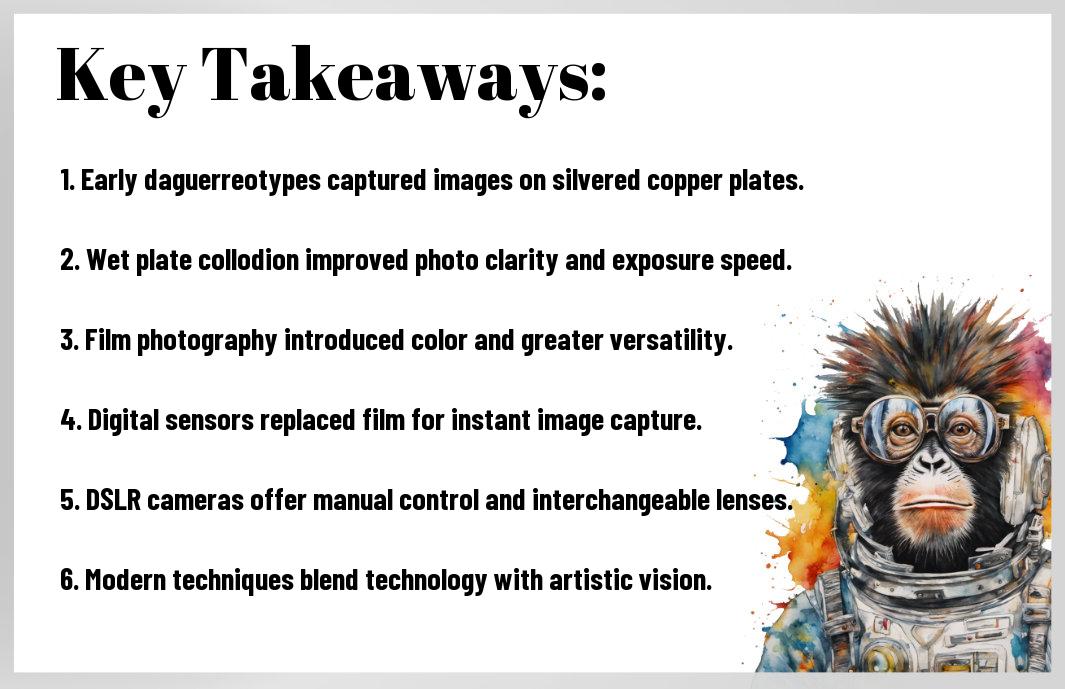
It’s fascinating to see how photography has evolved, shifting from the intricate processes of daguerreotypes to the ease of modern DSLRs. By understanding various photographic techniques throughout history, you can appreciate the artistry and technology that shaped today’s images. This journey not only enhances your knowledge but also inspires you to experiment with your photography, melding traditional methods with contemporary practices for your own unique style.
Unpacking the Daguerreotype: The First Leap in Photography
The daguerreotype, introduced in 1839 by Louis Daguerre, marked a revolutionary leap in capturing images. This pioneering photographic technique involved creating images on polished silver-coated copper plates. Each daguerreotype was unique, with intricate details that fascinated the public and set the foundation for modern photography’s evolution. Artists, scientists, and everyday people alike marveled at the ability to preserve a moment in time with remarkable realism.
The Science Behind the Process
The process of creating a daguerreotype required precision and considerable skill. First, the silver-plated copper plate was polished to a reflective finish before being sensitized to iodine vapors, which created a light-sensitive layer. After exposure in a camera, the plate underwent development using mercury vapor, which revealed the latent image. Finally, a fixed solution stopped the chemical process, and the result was a one-of-a-kind photograph that radiated detail and depth.
Cultural Impacts and Historical Significance
The introduction of the daguerreotype profoundly influenced society, transforming how you view the world and document moments. It demystified portraiture, making it accessible to the middle class and allowing families to preserve their legacies. Additionally, this innovation ignited public interest in photography, leading to its adoption across various fields, from journalism to art, forever changing cultural narratives and historical records.
As photography emerged in mainstream culture, daguerreotypes became pivotal in personal and social identity, allowing you to capture familial connections and document historical events. The format opened avenues for political commentary, as seen in the daguerreotypes of leaders and landscapes. Beyond mere representation, these images spurred conversations about memory, authenticity, and perception in society, ultimately laying the groundwork for future developments in visual storytelling and artistic expression.
The Evolution of Film Photography: Capturing the World
Film photography transformed how you perceive and capture moments, breathing life into images and allowing you to tell stories visually. In the early days, film was a complex world of delicate emulsions and light-sensitive materials, evolving into an accessible medium for the masses. From the first celluloid films to the now ubiquitous 35mm rolls, this journey reflects the intricate balance of art and technology. You will appreciate the craftsmanship that goes into film photography as it pioneered the way for modern image-capturing techniques and aesthetics.
From Roll Film to Instant Prints
The introduction of roll film in the late 19th century marked a significant turning point, giving you flexibility and convenience in photography. This medium paved the way for the development of portable cameras that anyone could use, making photography accessible. The later emergence of instant film, epitomized by Polaroid in the 1940s, offered immediate gratification, allowing you to see and share your captured moments within minutes, fundamentally altering the social dynamics around photography.
The Role of Photographic Styles in Documenting History
Your understanding of history is often framed through images, with photography playing a pivotal role in documenting societal changes and milestones. Each photographic style, from documentary to portraiture, offers a unique lens through which historical events are interpreted and understood. The stark realism of photojournalism, for instance, captures the raw emotions of conflict, while portrait photography can humanize historical figures, making their stories relatable and accessible. These styles not only reflect societal values but also shape public perception over time.
Consider the significant impact of styles like documentary photography during the Great Depression, where images by artists like Dorothea Lange not only portrayed suffering but also evoked empathy and prompted social change. Styles often dictate how events are perceived and remembered, as they frame narratives in ways that resonate with audiences. Furthermore, nostalgia-infused styles encourage reflection on past events, fostering a deeper connection to history through your lens. As you explore various photographic styles, their ability to document and influence history becomes evident, proving that photography is not just an art form but also a powerful means of communication.
Transitioning to Digital: The Game-Changer in Photography
The shift to digital photography marked a revolution that fundamentally transformed how you create and interact with images. Gone are the days of laboriously developing film; now, the immediacy of digital cameras allows you to see results almost instantly. This era democratized photography, enabling casual users and professionals alike to experiment with techniques that were previously the domain of skilled artists. As storage capacity increased and technology advanced, digital photography became an integral part of our daily lives and the way we communicate visually.
How Digital Sensors Revolutionized Image Capture
Digital sensors replaced film’s chemical processes with intricate arrays of photodiodes that convert light into electronic signals, fundamentally changing image capture. This advancement allowed for greater control of exposure and improved image quality, leading to higher resolutions and a wider dynamic range. Leading manufacturers increased sensor sensitivity, allowing you to capture brilliant images even in lower light environments. For instance, many modern DSLRs now feature sensors with eight times the resolution of a typical 35mm film frame, impacting how you approach photography and enabling even more creative possibilities.
The Rise of Smartphone Photography and Its Implications
Smartphones have transformed the photography landscape, allowing you to carry a powerful camera in your pocket at all times. This accessibility has not only skyrocketed the number of photographs taken daily but has also influenced how you interact with photography as a medium. With social media platforms dedicated to image sharing, the immediacy of capturing and disseminating visual content has made photography an integral part of personal and professional branding. Consequently, the boundaries between amateur and professional photography blur, encouraging a diverse array of styles and expressions.
The implications of smartphone photography extend far beyond personal snapshots; it has altered industries such as marketing, journalism, and art galleries. Brands increasingly rely on user-generated content, often sourced from social media, to showcase authentic moments and engage with audiences. This shift has led to new trends such as ‘influencer photography,’ where individuals create captivating visual narratives. With the simplicity of editing apps and filters, you can instantly enhance your photographs to meet community aesthetics. As a result, the traditional principles of composition and technique evolve, suggesting that creativity now thrives in your hands, regardless of expertise.
Mastering the Modern DSLR: Techniques for the Aspiring Photographer
Delving into the world of DSLR photography opens up a realm of possibilities where your creativity can flourish. By mastering the various functions and controls of your camera, you can capture stunning images that tell a story or evoke emotion. From manual settings to understanding the importance of light, your journey to becoming an accomplished photographer begins with grasping crucial concepts and techniques that elevate your skills to the next level.
Essential Settings for Optimal Exposure
Understanding the three pillars of exposure—aperture, shutter speed, and ISO—enables you to manipulate light like a professional. Adjusting the aperture controls the amount of light entering your lens, while shutter speed dictates how long that light is captured on your sensor. On the other hand, ISO measures your camera’s sensitivity to light. Balancing these settings will help you achieve the perfect exposure, enhancing your images, whether you aim for vibrancy or moodiness.
Composition and Creative Techniques for Stunning Images
Composition techniques such as the rule of thirds and leading lines guide the viewer’s eye and create visual interest. Experimenting with angles, framing, and negative space allows your images to stand out. Consider how texture, patterns, and balance contribute to the overall impact. Engaging with these elements not only enriches your photos but also helps convey deeper narratives within each frame.
Integrating creative techniques, such as long exposures or high dynamic range (HDR) imaging, can dramatically alter the aesthetic of your photographs. For instance, long exposures can create ethereal waterscapes, while HDR allows you to capture details in both shadows and highlights. You could also play with focal lengths to create compelling depth or use intentional blurring for artistic effect. Each technique invites you to step outside conventional boundaries and develop a signature style that is evocative and uniquely yours. Experimentation is key; the more you play with these techniques, the more you’ll discover your voice as a photographer.
The Future of Photography: Trends Reshaping the Landscape
Your understanding of photography is evolving with exciting trends that continue to reshape the landscape. As digital capabilities expand and consumer demands shift, photographers are leaning toward immersive experiences, like virtual reality and 360-degree images, alongside the integration of social media into photography. These trends not only captivate audiences but also push you to adapt your skills to stay relevant in a fast-paced environment.
The Impact of Artificial Intelligence on Capturing Images
AI is revolutionizing photography by automating processes and enhancing creativity. Tools powered by artificial intelligence can analyze compositions, suggest optimal settings, and even edit images, making it easier for you to achieve professional results without extensive post-processing skills. Apps leveraging AI technology, like Adobe Lightroom, allow for smart adjustments, enabling you to focus more on creative expression than technical details.
Emerging Technologies and Their Potential
Emerging technologies, such as computational photography and 3D printing, are pushing the boundaries of traditional photography. With smartphones equipped with advanced sensors and processing capabilities, stunning images are achievable in almost any scenario. Performance is further enhanced by features such as night mode and portrait lighting, which intelligently adapt to various environments. Additionally, 3D printing offers photographers the chance to create tangible versions of their work, merging art with physical form and providing innovative ways to share your portfolio.
Through computational photography, you can capture images that combine multiple exposures, enabling you to achieve detailed and vibrant photos that were once unattainable. The continued development in augmented reality (AR) also opens new doors, allowing you to overlay digital images onto the real world in real-time. As these technologies evolve, they not only redefine your workflow but also offer opportunities for unique storytelling and visualization. By embracing these advancements, you position yourself to explore new creative frontiers in photography.
Conclusion
To wrap up, exploring photographic techniques from the historical daguerreotypes to contemporary DSLRs allows you to appreciate the evolution of this art form. By understanding these methods, you can enhance your photographic skills and creativity. Each era’s innovations provide you with valuable insights into light capture and composition, opening new avenues for your artistic expression. Embracing these diverse techniques can enrich your photographic journey and inspire you to push boundaries in your photography.
Fine Art Photography Prints
Own a museum-quality archival print by Edin Chavez
Hahnemühle archival paper · From $95
BROWSE PRINTS LIMITED EDITIONS