Fine Art Photography
# Fine Art Photography Prints of the Everglades — Behind the Shot
There is a particular shade of pink that appears over the Everglades on certain winter mornings — not the postcard pink of a beach sunset, but something quieter and more complex, the color of the sky holding its breath before the first heron lifts off the water. I have driven to the park in complete darkness more times than I can count, and I will tell you honestly: most mornings don’t give you that color. But the morning that produced my most collected image gave me something I could not have planned for, and it changed how I think about photographing a place that most of the world has never truly seen.
The road into Everglades National Park from Homestead is one of the strangest drives in Florida. Within a few miles, the last gas station disappears in your mirror and you enter something older and quieter than anything else in the continental United States. I arrive before 5 a.m., before the tour boats, before the families with binoculars. There is a specific pull-off I’ve used for years — I won’t name it, because part of what makes these images possible is arriving alone — where the water sits flat and black and the sawgrass forms a perfect broken horizon. I set up my tripod in the dark, mostly by feel, and then I wait.
The waiting is not passive. I am reading the sky, watching where the clouds are thinning, checking the wind on the water’s surface, listening for the sounds that tell me the wildlife is about to move. My work for National Geographic trained me to think this way: the decisive moment in landscape photography is rarely when you press the shutter. It begins an hour before, when you commit to a position and decide what you’re asking the light to do.
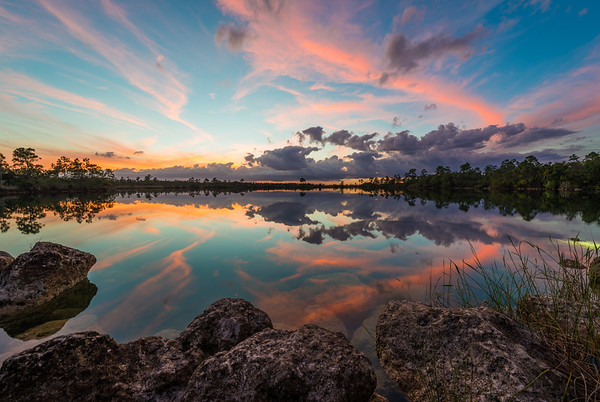
That particular morning — late January — the temperature had dropped overnight more than anyone expected, and low mist had settled over the water at ankle height. When the light finally came, it didn’t arrive as a sunrise so much as a slow illumination from underneath the clouds, turning the mist gold before touching anything else. I was shooting at a 4-second exposure, which meant the few ripples in the water smeared into a mirror, and the snowy egret that walked into the left edge of my frame became a ghost — a suggestion of white, perfectly balanced against the distant line of cypress trees.
That is the image. It doesn’t announce itself. It asks you to step into it.
Interior designers tell me that when clients see it installed — the 40×60″ version on a white wall in a Miami Beach living room — they go quiet before they say anything. That pause is what I’m after. It means the image is doing what I intended: putting you in the Everglades at 6:15 in the morning, far enough in that you can’t hear the highway, close enough to the water that you can almost feel the cool off it.
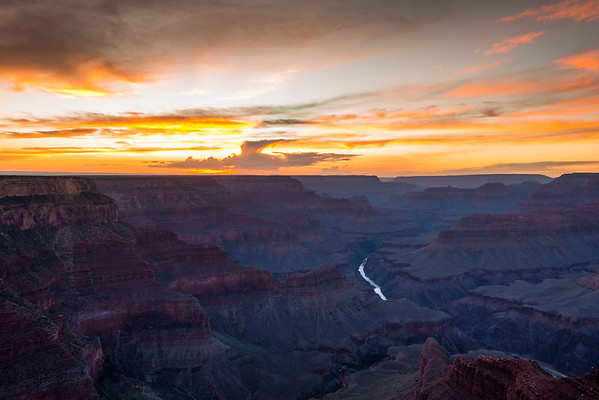
The Grand Canyon has thousands of fine art prints in circulation. Yosemite has been on gallery walls since Ansel Adams. But the Everglades — a UNESCO World Heritage Site, one of the most biodiverse ecosystems on Earth — is almost entirely absent from serious fine art collections.
Part of that is access. You can’t walk into the Everglades the way you walk to the rim of the Grand Canyon. The light moves differently here, influenced by heat and humidity in ways that require familiarity, not just a good camera. The drama is subtle — this is not a place of vertical cliffs and theatrical storms. The Everglades asks you to slow down and pay attention, and that is not a skill that develops quickly.
For collectors, that rarity is significant. When a subject is underrepresented in fine art photography and you have the opportunity to acquire a museum-quality image of it in a small edition, you are acquiring something that will not be replicated. My Everglades fine art photography prints are among the few serious interpretations of this landscape in the collector market — and that distinction is part of what gives them lasting value.
Every print in my Everglades collection is produced as an archival giclée on Hahnemühle Photo Rag or baryta paper through WHCC, which produces museum-quality printing used by galleries and institutions. The inks are rated for over 100 years without fading under normal display conditions. These are not photographs printed at a photo lab. They are fine art prints produced to gallery standards, with the tonal range and color accuracy that the original file was captured to deliver.
The paper choice matters for a subject like the Everglades. The softness of fine art rag paper suits the quiet, atmospheric quality of these images in a way that glossy media cannot. When you stand in front of a large-format Everglades print on rag paper, the surface texture recedes visually and lets the image come forward.
My Everglades fine art photography prints are released in limited editions of 50 across all sizes. Once all 50 are sold, the image is retired permanently. No reprints, no exceptions. Each print is numbered, signed, and accompanied by a certificate of authenticity.
The edition size is deliberate. Fifty is small enough to be genuinely scarce — a number chosen because I believe in editions that actually end. As the edition sells through, the price increases at specific breakpoints: editions 1–10 are priced at one tier, editions 11–25 at the next, and so on. Collectors who acquire early see the most appreciation as the edition closes. Several collectors who purchased my earlier landscape editions at first-release pricing have watched the current edition price nearly double.
This is how fine art photography should work — not as a commodity, but as a collectible with genuine scarcity and a transparent pricing structure.
The Everglades is one of the great subjects in American landscape art, and it has been waiting for the collection it deserves. If you’ve been considering bringing a piece of Florida’s wild interior into your home, I’d be glad for you to see what’s available.