Your journey into the world of photography begins with understanding the vital strategies that can elevate your skills. This guide will walk you through practical techniques to enhance your photography, whether you’re a beginner or looking to refine your craft. From mastering composition and lighting to exploring different camera settings, you’ll gain the insights needed to capture stunning images. Get ready to commence on an exciting adventure where you unleash your creativity and develop a confident eye for photography.

Understanding Photography Basics
Before delving deeper into the world of photography, it’s important to grasp the fundamental concepts that form the backbone of this art form. Understanding photography basics equips you with the knowledge needed to capture stunning images and enables you to make informed decisions while shooting. From learning about composition to familiarizing yourself with camera settings, these foundational principles will significantly influence your creative journey.
Essential Equipment and Gear
There’s a wide array of gear available for photographers, but you don’t need everything to get started. A quality camera, whether it’s a DSLR, mirrorless, or even a smartphone, can serve as your primary tool. Additionally, investing in a sturdy tripod, a versatile lens, and basic editing software will provide you with the important equipment to elevate your photography.
Mastering Exposure Settings
Essential to achieving great photographs, mastering exposure settings involves understanding three pivotal elements: aperture, shutter speed, and ISO. These settings work together to control the amount of light entering your camera, impacting how bright or dark your images appear.
Basics of exposure settings start with aperture, which determines how much light your lens lets in; a lower f-stop number means a wider opening and more light. Shutter speed controls how long that light hits the sensor, where faster speeds freeze motion and slower speeds can create beautiful motion blur. Finally, ISO measures your camera’s sensitivity to light—higher ISO can help in darker conditions but may introduce noise. Mastering these three elements allows you to manipulate light creatively, enhancing your photography skills significantly.
Composition Techniques
Assuming you want to elevate your photography skills, mastering composition techniques is vital. These methods help you create compelling and visually appealing images that resonate with your audience. By experimenting with different approaches to framing and arrangement, you’ll be better equipped to tell your unique story through photography. Let’s investigate some key strategies that will enhance your photographic composition.
Rule of Thirds and Beyond
Rule of Thirds is a fundamental guideline that encourages you to divide your frame into nine equal parts by two horizontal and two vertical lines. Positioning your subject along these lines or at their intersections can create balance and visual interest. However, once you’re comfortable with the Rule of Thirds, feel free to explore other compositional techniques, such as symmetry, balance, and negative space, to develop your own unique style.
Leading Lines and Framing
One effective method to draw attention in your photographs is through leading lines and framing. Leading lines direct your viewer’s eye toward the main subject, providing depth and context within your image. You can utilize roads, pathways, or natural elements like rivers or fences to guide the viewer’s gaze. Framing, on the other hand, involves using elements in your scene to create a ‘frame’ around your subject, adding layers and depth to your composition.
To maximize the impact of leading lines and framing, look for opportunities in your environment to incorporate these elements. Seek out natural or architectural textures that can create strong lines leading to your subject. Utilizing framing techniques, such as doorways or overhanging branches, enhances the focus on your main subject while also providing an immersive experience for your viewer. Experimenting with these techniques can significantly improve the storytelling aspect of your photos.
Lighting Considerations
Not all light is created equal, and mastering the art of lighting can elevate your photography from ordinary to extraordinary. Understanding how to manipulate light sources, both natural and artificial, allows you to craft stunning images that resonate with emotion and atmosphere. Whether you’re shooting indoors or outdoors, the right lighting can make all the difference in capturing the perfect shot.
Natural vs. Artificial Light
Natural light can dramatically enhance your photography, providing soft shadows and vibrant colors. It varies throughout the day, making the golden hour—shortly after sunrise or before sunset—a favorite among photographers. Conversely, artificial light can offer precision and control, allowing you to create specific moods or effects. Balancing these light sources helps you achieve your desired outcome, so think about what best suits your subject.
Using Reflectors and Diffusers
Reflectors can amplify and redirect available light, while diffusers work to soften harsh rays and create an even, flattering illumination. Both tools are necessary in your photography kit as they allow you to control the intensity and direction of light in your images.
Understanding how to utilize reflectors and diffusers can greatly enhance your lighting techniques. Reflectors come in various sizes and colors, allowing you to introduce warmth or coolness to your images. Positioning a reflector opposite to your light source can fill in shadows, making your subject pop. On the other hand, diffusers help when you want to soften direct sunlight or eliminate harsh shadows. By mastering these tools, you can gain greater creative control over your photography, leading to more polished and professional-looking images.

Tips for Capturing Motion
All photographers can enhance their skills by mastering the art of capturing motion. To achieve stunning dynamic shots, consider these practical tips:
- Use faster shutter speeds for freezing action.
- Experiment with slow shutter speeds for blurring motion.
- Incorporate panning techniques for a sense of speed.
- Pay attention to your subject’s movement direction.
Any effort you make to improve your motion photography will lead to more dramatic and engaging images.
Shutter Speed Techniques
Shutter speed is vital when you’re capturing motion. For fast subjects, using a high shutter speed (such as 1/500s or faster) will freeze the action and provide clarity. For slower-moving subjects, you can opt for a slower shutter speed to allow some blur, creating a sense of movement. Balance is integral; a basic understanding of how shutter speed interacts with ISO and aperture will set you on the right path.
Panning and Freezing Motion
Little techniques like panning and freezing motion can elevate your photography. Panning involves moving your camera along with your subject’s movement, while freezing motion captures a fleeting moment in its entirety.
For instance, when photographing a runner in a race, you can time your shot to follow their movement with your camera while using a slower shutter speed. This creates a background blur that emphasizes speed, making the runner stand out sharply in focus. By practicing these techniques, you can convey the energy and excitement of motion in your photographs, effectively highlighting the subject’s action.

Post-Processing Strategies
Unlike the assumption that a photograph is perfect straight out of the camera, post-processing allows you to refine and enhance your images. By utilizing various techniques, you can correct minor imperfections, adjust colors, and add creative touches that elevate your work. Embracing these strategies not only improves your photos but also helps you develop your unique visual style. Start exploring the world of post-processing to unlock the full potential of your photography journey.
Editing Software Overview
You have a plethora of editing software options available to elevate your photographic work. From user-friendly applications like Adobe Lightroom to more advanced tools like Adobe Photoshop, each program offers distinct features that cater to different skill levels and needs. Assess your requirements and workflow to choose the software that aligns best with your vision and goals as a photographer.
Enhancing Your Photographs
Post-processing is where you can truly transform your images into captivating pieces of art. By adjusting exposure, contrast, and saturation, you can breathe new life into your photographs. Furthermore, cropping and straightening can help you achieve better composition, while filters and presets can add unique stylistic effects. Experiment with these tools to find what resonates with your creative vision, and don’t hesitate to refine your process over time.
Software provides a variety of tools to enhance your photographs effectively. Start with basic adjustments like exposure and white balance to correct any inconsistencies. As you gain confidence, explore advanced techniques such as layering, mask applications, and blending modes to create dynamic effects. Tools like sharpening and noise reduction can also fine-tune the overall quality of your images. By experimenting with these features, you’ll discover how subtle adjustments can dramatically impact the final result, helping your photos stand out. Embrace the post-processing journey to make each image uniquely yours.
Developing Your Own Style
To cultivate your unique photography style, immerse yourself in various influences while allowing creativity to guide your vision. Explore different genres, subjects, and techniques that resonate with you. Experiment with diverse compositions, lighting, and post-processing methods to discover what truly reflects your artistic voice. As you practice, your individual perspective will begin to shine through your work, setting you apart from others.
Finding Inspiration
Clearly, inspiration can be drawn from numerous sources, including art, nature, and even everyday moments. Pay attention to the world around you and observe how light interacts with your environment. Visit galleries, read photography books, or follow photographers on social media that evoke a strong emotional response. Allowing yourself to be open to these influences can spark your creativity and help you find what inspires you most.
Creating a Unique Portfolio
To showcase your distinct style, focus on assembling a portfolio that represents your best work while reflecting your individual approach. Curate images that demonstrate your unique perspective and thematic emphasis. Aim for cohesion in your selection, as this will convey your artistic vision more effectively to others.
It’s important to regularly update your portfolio with fresh content that reflects your growth as a photographer. Include projects that excite you and illustrate your evolution. Interactive elements, such as behind-the-scenes shots, can also provide deeper insight into your creative process. Ultimately, your portfolio should tell a compelling story about your artistic journey and invite viewers to connect with your work on a personal level.
Summing up
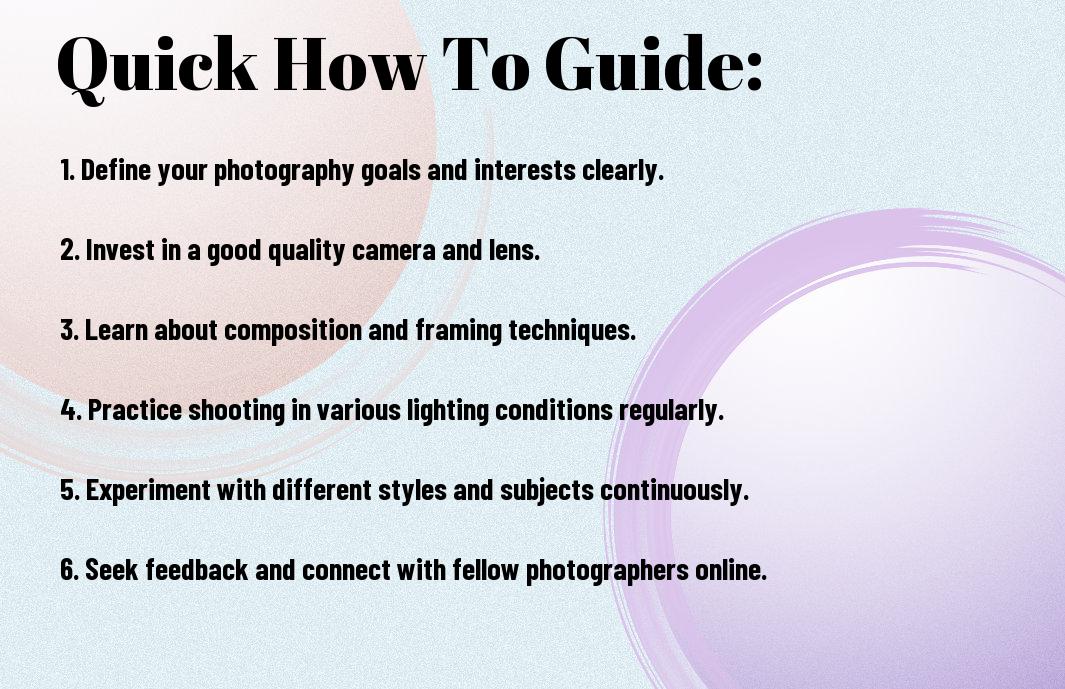
To wrap up, launching on your photography journey requires commitment and practice. By implementing these practical strategies, you can enhance your skills and develop your unique style. Focus on understanding your equipment, mastering composition, and experimenting with different techniques. Don’t shy away from seeking feedback and continuously learning from your experiences. As you embrace these approaches, you’ll find your confidence and creativity blossoming, empowering you to capture stunning images that reflect your vision.
Fine Art Photography Prints
Own a museum-quality archival print by Edin Chavez
Hahnemühle archival paper · From $95
BROWSE PRINTS LIMITED EDITIONS