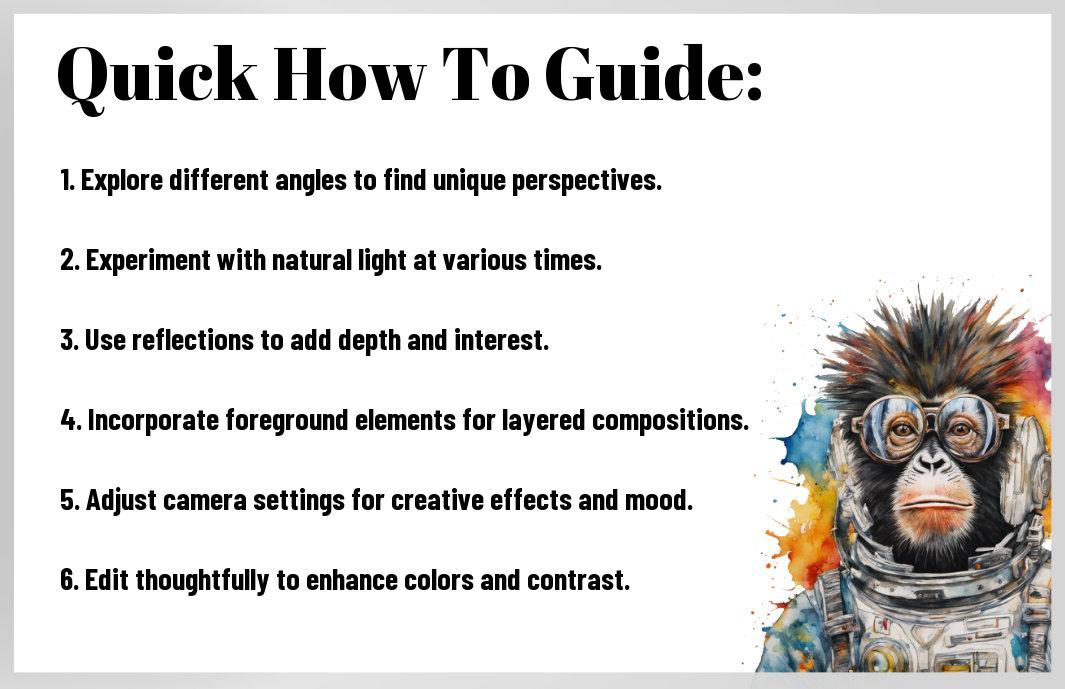
You have the ability to elevate your photography skills with some creative techniques that can transform your images from ordinary to extraordinary. By integrating innovative tricks into your routine, you can enhance your composition, lighting, and overall aesthetic. This guide will provide you with actionable tips that will inspire you to experiment and explore new perspectives in your photography journey. Get ready to unlock your potential and capture stunning visuals that truly reflect your unique artistic vision.
Capturing the Unseen: Finding Unique Perspectives
Unearthing the unexpected in your photography can transform ordinary subjects into extraordinary art. Shifting your viewpoint and actively seeking out angles that others might overlook is a fascinating exercise. Whether it’s an extreme low angle that draws attention to the sky or a bird’s-eye view revealing patterns below, playing with perspective opens up a new world of possibilities. Consider how shadows and light interact with your subject to enhance the storytelling in your images, creating a compelling visual narrative that surprises and captivates your viewers.
Breaking Free from Conventional Angles
Exploring unconventional angles can reshape the way you perceive your subjects. Instead of sticking your camera at eye level, experiment with shooting from a crouch or standing on an elevated surface. This not only adds depth but can also highlight emotional elements within the scene. The dynamic shift in perspective breathes life into your photographs, making mundane images feel fresh and engaging. Taking a shot through an archway, for instance, can imbue your final image with a natural frame, guiding the viewer’s eye in a unique way.
The Art of Framing and Composition
Mastering framing and composition can elevate your photography from simple snapshots to impactful artworks. Utilizing elements within the environment to create natural frames draws attention to your subject, enhancing the overall impact of the image. Additionally, consider the rule of thirds; placing points of interest along grid lines helps achieve a balanced and visually appealing composition. Leading lines, such as roads or pathways, can guide the viewer’s eye deeper into the image, inviting them to explore the scene further. Experimenting with symmetry and asymmetry also adds layers of intrigue, creating a more engaging visual experience.
Beyond basic techniques, the heart of framing and composition lies in your ability to convey a story. Imagine capturing a child walking hand-in-hand with a parent, framed by colorful trees in the foreground. This not only directs focus but creates an emotional connection between your subject and the viewer. By thoughtfully placing elements in the foreground, mid-ground, and background, you can produce depth and context, turning your photographs into immersive experiences. Engaging with various compositional techniques allows you to develop a distinctive style while also challenging viewers to see the world through your lens.
Mastering Light: The Photographer’s Greatest Ally
Harnessing light effectively elevates photography from mere snapshots to stunning visual storytelling. Master your understanding of both natural and artificial light to manipulate exposure, mood, and the overall feel of your images. By knowing how to use different types of light to your advantage, you can create breathtaking photographs that capture the essence of your subjects, whether they are landscapes, portraits, or still life.
Natural vs. Artificial Light: When to Use Each
Natural light offers a dynamic range that can enhance your compositions beautifully, particularly during the golden hour—just after sunrise or before sunset. Conversely, artificial light grants you complete control over the environment, allowing for creative experimentation even in challenging settings. Use natural light for its soft richness, but consider artificial sources like flash or studio lights to highlight specific elements or achieve unique effects when the situation demands it.
Understanding Shadows and Highlights to Craft Mood
Moods are felt, not just seen. Shadows and highlights play a crucial role in evoking emotion and depth in your work. Strong contrasts can create drama and tension, while soft lighting can inspire warmth and comfort. Explore the play between light and shade in your composition to highlight key features of your subject, draw viewers into the story, or even evoke nostalgia. Think specifically of how chiaroscuro techniques used by Renaissance painters can translate into modern photography, creating striking images full of life and narrative.
Delving deeper into shadows and highlights allows you to paint your scene with light. Consider how the low angle of light during sunrise can create long, expressive shadows adding depth to a portrait or landscape. Alternatively, an overcast day provides a soft box effect, reducing shadows and creating a gentle mood ideal for capturing portraits or delicate subjects. Experimenting with these elements can lead to rich emotional expressions, making your images more engaging and thought-provoking. Take the time to study your surroundings and observe how light interacts with various surfaces, utilizing these insights to refine your photographic vision.
The Power of Storytelling: Creating Narratives Through Images
Images hold the ability to weave narratives that evoke feelings, thoughts, and responses far beyond what words can convey. Your photography can transform simple scenes into compelling tales, guiding viewers through emotional journeys. Each click of the shutter provides a moment to convey messages, whether it’s the raw essence of joy, despair, or triumph. By infusing your images with storytelling elements, you’ll engage your audience on a deeper level, making your work more memorable and impactful.
Elements of Visual Storytelling
Visual storytelling hinges on several key elements, including composition, subject matter, and context. Each element plays a vital role in guiding your viewer’s eye and shaping their interpretation of the image. Positioning your subject within a meaningful environment can create layers of meaning, while choosing specific colors and lighting can influence the mood of the narrative. Additionally, consider the sequences in your shots—how they flow together can build a powerful story arc.
Utilizing Emotion to Connect with Your Audience
Emotional resonance is a compelling tool in visual storytelling. Elements like facial expressions, body language, and the surrounding environment all work together to convey feelings that can stir the viewer’s empathy. When you capture a moment filled with genuine emotion—be it sorrow, joy, or contemplation—you invite the audience into a shared experience, blurring the line between the observer and the observed.
Deepening the emotional connection in your photography enhances its storytelling power. For instance, images depicting everyday moments infused with human emotion, such as a child’s laughter or a couple sharing an intimate look, resonate universally. Incorporating strong contrasts, such as light and shadow or vibrant versus muted colors, can also heighten mood and evoke specific responses. You might photograph the aftermath of a storm, where the melancholy of dark clouds battling against golden rays of sunlight can evoke a sense of hope and struggle. These dynamics allow viewers to not just see, but feel the story unfolding in each frame, encouraging them to connect with your work personally.
Essential Techniques: Tricks Professional Photographers Swear By
Mastering the art of photography often hinges on employing techniques that elevate your images from ordinary to extraordinary. These insider tips, honed through years of experience, can help you capture stunning photographs that resonate with viewers. By integrating these strategies, you’ll refine your skills and develop a unique style that sets your work apart from the rest.
Advanced Focus Techniques for Stunning Detail
Your ability to focus can make or break a photo. Utilize techniques such as selective focusing or focus stacking to draw attention to your subject in a dynamic way. These methods allow you to create images rich in detail while emphasizing important elements within the frame. The difference is particularly clear in macro photography where the finest details often define the impact of your shot.
- Use a shallow depth of field to blur distracting backgrounds while highlighting your subject’s clarity.
- Try focus peaking on manual lenses to ensure precision in your focus points.
- Experiment with multiple focal points when photographing landscapes or intricate subjects.
- Incorporate autofocus modes like continuous tracking for moving subjects.
- Combine different images for focus stacking to ensure maximum sharpness in your final output.
| Technique | Description |
|---|---|
| Selective focusing | Focus on a specific subject to isolate it against a soft, blurred backdrop. |
| Focus stacking | Taking several images at different focus points and blending them for clarity throughout. |
| Macro focus | Using macro photography techniques to bring minute details into striking view. |
Utilizing Props and Backgrounds to Elevate Your Shots
Incorporating props and backgrounds can significantly transform your photography. Well-chosen elements add depth and contextual storytelling, enhancing visual interest. Your surroundings or selected props offer opportunities to play with colors, textures, and shapes that complement your subject and elevate the overall composition.
Choosing the right prop or background sets the stage for your subject, creating a narrative in every shot. For instance, using a vintage chair in a portrait can evoke a sense of nostalgia, while an urban backdrop might convey a contemporary vibe. Textured surfaces, like wood or fabric, can add richness to your images. Think outside the box and incorporate everyday items, like flowers or fabrics, to frame or highlight your subject effectively. This creative approach not only draws the viewer’s eye but also adds a layer of personality and creativity to your photos, making them memorable and impactful.
Post-Processing Magic: Transforming Your Images
Post-processing is where the true magic happens; it allows you to enhance your images beyond the raw capture. With the right techniques and tools, you can adjust colors, refine details, and create a mood that elevates your photography to new heights. By understanding how adjustments can impact the final look, you gain the ability to communicate your unique vision through each photograph.
Editing Essentials: Tools and Techniques for Beginners
Getting started with editing requires simple tools that can make a significant difference. Programs like Adobe Lightroom and Photoshop offer user-friendly interfaces with imperative features such as cropping, color correction, and exposure adjustments. Familiarize yourself with the histogram to ensure you’re capturing an optimal range of light and shadow, and explore presets or filters to streamline your workflow while still allowing for personal touches.
Overcoming Common Editing Pitfalls
Many beginners fall into the trap of over-editing, leading to unnatural images. Balancing adjustments is key; focus on subtle tweaks instead of drastic changes. Learning to recognize when your photo becomes too saturated or contrast-heavy is imperative. Break the habit of relying solely on one-click filters and instead develop your editing eye, which will yield more authentic results that reflect your style.
Over-editing often stems from the desire to make every image pop instantly, yet this can easily distort reality. A common mistake is pushing saturation too far, which can render skin tones unnatural and overshadow the photograph’s original intent. Instead, aim for a balanced approach by applying edits selectively. Use adjustment layers to experiment without permanently altering your original image. By refining your technique and keeping a critical eye, you can achieve stunning results that maintain the integrity of your subject while showcasing your artistic flair.
To wrap up
Hence, by implementing these creative how-to tricks, you can significantly enhance your photography skills. Experimenting with different techniques, understanding your equipment, and tapping into your unique perspective will empower you to capture stunning images. Embrace every opportunity to practice and learn, and soon you’ll see an evolution in your photography that reflects your personal artistry and vision. Keep pushing boundaries, and don’t hesitate to explore new concepts that can elevate your craft.
Fine Art Photography Prints
Own a museum-quality archival print by Edin Chavez
Hahnemühle archival paper · From $95
BROWSE PRINTS LIMITED EDITIONS