Beginners often feel overwhelmed when submerging into the world of photography, but mastering the basics is key to unlocking your creative potential. In this guide, you will learn imperative techniques and tips that will help you develop your skills and enhance your understanding of composition, lighting, and camera settings. Whether you’re using a smartphone or a DSLR, this comprehensive overview will set you on the path to capturing stunning images and expressing your unique vision. Let’s initiate on this exciting journey together!
Understanding Photography Basics
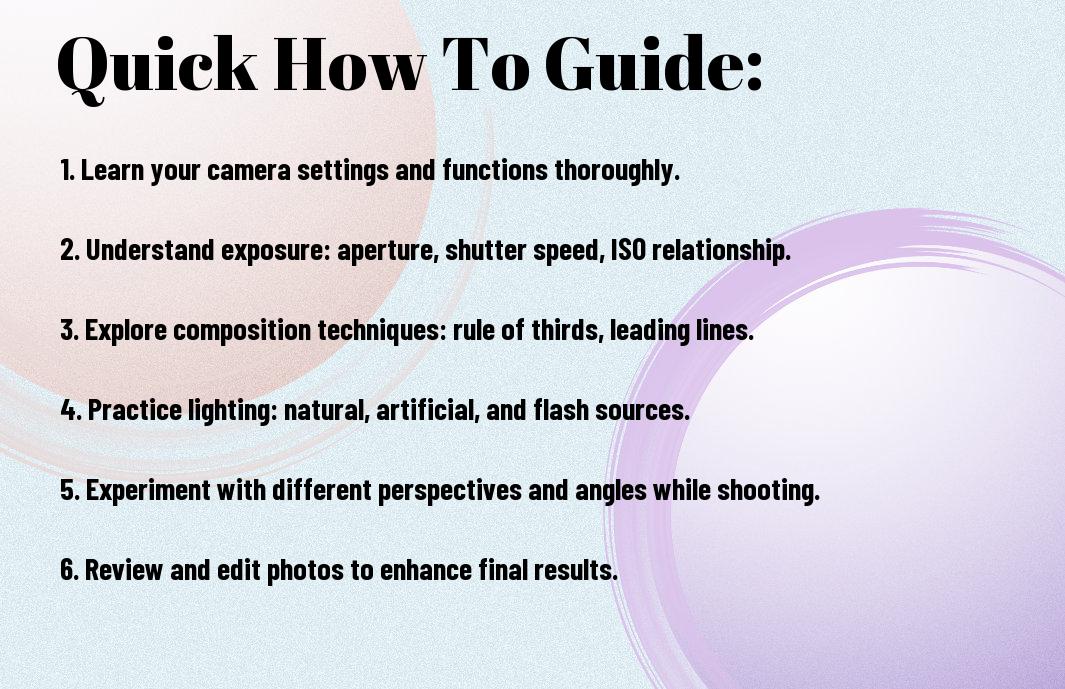
As a beginner in photography, mastering the basics is imperative for developing your skills. This foundational knowledge will not only help you understand how different elements contribute to creating stunning images but also empower you to experiment and find your unique style. Engage with concepts like exposure, lighting, composition, and camera settings to elevate your photography journey.
How-to Choose the Right Camera
Assuming you are stepping into the world of photography, selecting the right camera can be overwhelming. Consider factors such as budget, purpose, and your level of experience. Determine whether you prefer a compact point-and-shoot, a versatile DSLR, or a mirrorless camera that offers flexibility and advanced features. Look for a camera that fits comfortably in your hands, allowing you to practice confidently and effectively capture your artistic vision.
Tips for Selecting Lenses
An imperative part of photography involves choosing the right lenses to enhance your creativity. Consider the type of photography you plan to pursue, as different lenses serve specific purposes. Here are some valuable tips:
- Understanding focal length helps you capture wide-angle landscapes or close-up portraits.
- Evaluating aperture allows you to control light and depth of field for a pleasing background blur.
- Exploring prime versus zoom lenses offers various flexibility and image quality options.
Knowing the functionalities of each lens will greatly influence your photography.
Another important aspect when selecting lenses is understanding compatibility with your camera system. Always check your camera’s mount type and sensor size to ensure alignment with the lenses you consider. Here are some more tips:
- Research lens brands that produce high-quality options for your camera type.
- Test out different lenses to see how they perform in real-world situations.
- Consider investing in a versatile zoom lens as a great starting point.
Knowing these tips will help you make informed decisions when building your photography gear.
Mastering Exposure
Assuming you want to elevate your photography skills, understanding exposure is key. Exposure determines how light or dark an image appears, and it is controlled by three main components: ISO, shutter speed, and aperture. Mastering these elements will allow you to capture the mood and detail in every shot, giving you full creative control over your photographs.
How-to Use ISO, Shutter Speed, and Aperture
With your camera ready, start by adjusting the ISO setting, which controls your sensor’s sensitivity to light. Lower ISO values are ideal for bright conditions, while higher values are necessary in low light but may introduce noise. Next, set the shutter speed; faster speeds freeze motion, while slower speeds can capture movement blur. Finally, choose the aperture, which affects the depth of field and allows you to control how much light enters the lens.
Factors That Affect Exposure
Shutter speed, aperture, and ISO all play a role in how you achieve a well-exposed photograph. Various external factors also impact your exposure decisions:
- Lighting conditions – Bright vs. dim environments
- Subject movement – Is your subject still or in motion?
- Distance from the subject – Closer subjects can be more easily focused
- Time of day – Golden hour offers softer light
The interplay of these factors allows you to create images that are both technically sound and artistically compelling.
Affecting your exposure decisions requires an understanding of ambient light and how it interacts with your settings. To effectively gauge this interaction, consider:
- Weather conditions – Overcast vs. sunny influence lighting
- Reflective surfaces – How do they affect light bounce?
- Time constraints – Do you have time to adjust settings on-the-fly?
- Camera metering modes – Which mode best suits your scene?
The finer points of these factors can help you adapt quickly, ensuring your photos capture the light exactly as you envision.

Composition Techniques
To enhance your photography, mastering composition techniques is imperative. By understanding how to frame your shots and utilize innovative perspectives, you can create visually striking images that captivate your audience and convey your intended message effectively.
How-to Frame Your Shots
There’s an art to framing your shots that can greatly influence the final outcome of your photographs. Utilize elements like foreground, background, and leading lines to guide your viewer’s eyes and tell a story through your images. Experimenting with different focal points and compositions can result in captivating photos that stand out.
Tips for Innovative Perspectives
If you want to elevate your photography, exploring innovative perspectives can add depth and interest to your work. Consider the following tips to change your approach:
- Get low or high to alter your viewpoint.
- Crop tight to focus on details.
- Use reflection or shadows creatively.
Knowing your surroundings and being open to unconventional angles can lead to unique and captivating compositions that engage your viewers like never before.
Shots taken from unexpected angles can provide fresh perspectives that make your work stand out. To explore this further, consider these approaches:
- Use a wide-angle lens for exaggerated perspectives.
- Frame your subjects through natural elements.
- Invert typical angles to challenge norms.
Knowing how to harness these innovative perspectives will allow you to create visually compelling photographs that resonate with your audience and showcase your unique style.

Utilizing Natural Light
Not all light is created equal, so understanding how to effectively use natural light can dramatically enhance your photography. Embrace the elements around you, and learn to manipulate natural light to your advantage. Whether you’re shooting landscapes, portraits, or still life, the right lighting can breathe life into your images and bring out their true potential.
How to Identify Ideal Lighting Conditions
Little things can make a big difference in lighting conditions. Observe how light affects your subject at different times of the day; early morning or late afternoon often offers soft, diffused light that is ideal for photography. Pay attention to shadows and highlights to determine the best light for capturing your vision.
Factors Influencing Natural Light
Ideal natural light can vary greatly due to several key factors. Consider these elements when preparing for a shoot:
- The time of day affects the color and intensity of natural light.
- Weather conditions can either diffuse or enhance natural light.
- Surrounding environments can cast shadows or reflect light, altering the overall effect.
- Season changes bring differences in sunlight angles and duration.
- Assume that all these factors can be combined in unique ways to create distinctive lighting conditions.
Identify the specific circumstances that affect your shooting environment. For instance, think about the direction of the sun and how it interacts with your subject. Understanding these variables will help you capture stunning images even in challenging situations.
- Soft light typically occurs on overcast days, ideal for portraits.
- Golden hour light, shortly after sunrise or before sunset, offers warm tones.
- Shadows can create depth but may also obscure details; use them wisely.
- Reflective surfaces nearby can introduce interesting light effects.
- Assume that by adapting to these conditions, you will hone your skills and improve your images.

Post-Processing Essentials
Now that you’ve captured stunning images, it’s time to elevate them through post-processing. This stage allows you to refine your work, correct any flaws, and bring your creative vision to life. With the right approach, you can transform your photos into striking pieces of art, making post-processing a vital part of your photography journey.
How-to Edit Your Photos
Your editing process should start with a clear vision of the final image you want to achieve. Begin by adjusting basic elements such as exposure, contrast, and color balance. As you gain confidence, explore more advanced techniques like cropping, layering, and applying filters for creative effects, ultimately enhancing the overall impact of your photographs.
Tips for Using Editing Software
Using editing software effectively can vastly improve your photography skills. Familiarize yourself with important tools and options offered by programs like Adobe Lightroom or Photoshop to maximize your editing results. Here are some tips to guide you:
- Keep your edits non-destructive for flexibility.
- Use presets to streamline your workflow.
- Experiment with different techniques to discover your unique style.
- Don’t overload your images with too many adjustments.
Any time you edit, take it slowly and ensure each adjustment improves your image without overwhelming it.
Post-Processing can seem daunting at first, but with practice and experimentation, you will master the software. Familiarity with shortcuts and tool placement can significantly improve your efficiency. Consider attending online tutorials or watching video guides to enhance your skills further. Here are some additional tips:
- Always work in high-resolution formats.
- Back up your original images and edits.
- Utilize layer masks for more controlled edits.
- Stay organized by naming layers and saving versions of your work.
Any newfound techniques you embrace will only expand your editing repertoire.
Developing Your Photography Style
All photographers develop a unique style over time, which reflects their personality and vision. This is an imperative step toward becoming not just a technician but an artist in your craft. By combining your interests, experiences, and the techniques you learn, you’ll create captivating images that stand out. Embrace the journey of refining your style and let your creativity lead you toward discovering what truly resonates with you.
How-to Experiment and Find Your Unique Voice
Some of the best ways to discover your unique voice in photography is through experimentation. Take risks by trying different genres, techniques, and editing styles to see what speaks to you. Don’t hesitate to break the rules and push the boundaries of traditional photography; this exploration will help you unearth your individuality and distinctive perspective.
Factors That Influence Personal Style
Developing your personal photography style is affected by several factors. Consider the following elements that shape your artistic expression:
- Your interests and passions
- Inspirations from other artists
- The equipment you use
- Your experiences and stories
- Different cultural influences
After reflecting on these factors, you’ll begin to see a clearer picture of how to shape your unique style.
Influencing elements can significantly shape your artistic direction. Your interests in specific subjects, coupled with your emotional and cultural experiences, will meld into a distinctive aesthetic. Keep in mind that the tools and techniques you choose, along with the inspirations you draw from, also contribute to your overall style. It’s imperative to continuously learn and adapt as your experiences evolve.
- Current trends in photography
- The feedback you receive from peers
- The impact of your environment
- Your personal journey and growth
After evaluating these influences, you’ll gain a deeper understanding of your photographic voice.
Conclusion
Ultimately, mastering the basics of photography is key to enhancing your skills and unleashing your creativity. By understanding your camera settings, composition techniques, and lighting principles, you can capture stunning images that resonate with your audience. As you practice and experiment, you will find your unique style and voice as a photographer. Stay curious and dedicated to continuous learning, and you’ll see your photography evolve and improve over time. Embrace the journey, and enjoy every moment of creating captivating visuals.
Fine Art Photography Prints
Own a museum-quality archival print by Edin Chavez
Hahnemühle archival paper · From $95
BROWSE PRINTS LIMITED EDITIONS